


![Attorney Marco Mellone during oral arguments at the Court of Cassation in Rome, at the United Sections hearing on the 'child issue' | Photo: Reproduction/[source of the video]](https://italianismo.com.br/wp-content/uploads/2026/07/marco-mellone-600x337.jpg)

































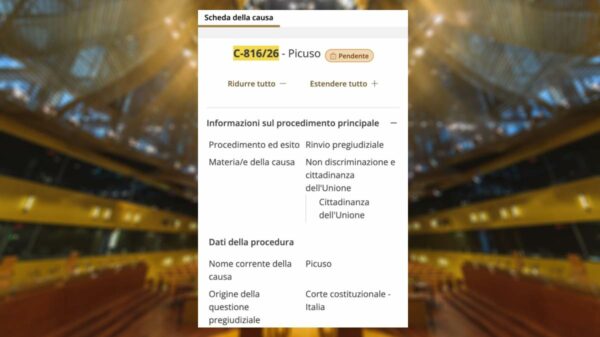
O process C-816/26The case, which takes the discussion about the new rules of Italian citizenship by descent to the Court of Justice of the European Union, has been officially named... Picuso.
Anyone searching for a person or family with that surname, however, will not necessarily find one of the parties involved. Picuso is a name entirely invented by the Court of Justice itself to preserve the identity of the individuals connected to the case.
Privacy in Luxembourg
Since January 2023, the Court of Justice has been using fictitious names in prejudicial referrals involving individuals.
According to the court itself, these names are generated by a computerized system with artificial intelligence that divides words into syllables and combines them randomly. Therefore, Picuso is not a pseudonym chosen by those involved, nor does it offer any clue about their real names.

The Supreme Court reaffirmed: citizenship is born with the person.
- New legal front opened
- Processes can still be filed.
- Individual assessment before any decision.
The goal is to allow the process to be identified and publicly cited without permanently associating a person's real name with a high-profile international legal case.
The official case file lists Picuso as the "current name of the case." Case C-816/26 was registered on July 23, 2026, and appears as pending before the Court of Justice.
The story behind the name
The process originated from the preliminary ruling determined by the Italian Constitutional Court. in Ordinance 147/2026.
The decision suspended the trial concerning Article 3-bis of Law 91/1992 and asked the Court of Justice to clarify whether the new Italian rules on citizenship by descent are compatible with Articles 9 of the Treaty on European Union and 20 of the Treaty on the Functioning of the European Union.
In this type of procedure, Luxembourg does not directly decide who is or is not entitled to recognition of Italian citizenship. The Court answers questions about the interpretation of European Union law. Then, it will be up to the Italian Constitutional Court to resume the judgment and apply the ruling to the national case.
In practice, "Picuso" is the name that lawyers, interested parties, and media outlets should follow on the Court's website to check public acts of the process, such as the scheduling of any hearings, the presentation of possible conclusions by the Attorney General, and subsequently, the decision.
The Court clarifies that the process has a written phase and may have an oral phase. Holding a hearing and the presentation of the Advocate General's conclusions are not automatic, as they depend on a decision by the court itself.













![Attorney Marco Mellone during oral arguments at the Court of Cassation in Rome, at the United Sections hearing on the 'child issue' | Photo: Reproduction/[source of the video]](https://italianismo.com.br/wp-content/uploads/2026/07/marco-mellone-100x100.jpg)