























If a large part of the immigration to Southern Brazil came from Northern ItalyA large portion of those who arrived in São Paulo and Espírito Santo came from the South, especially from Campania. And there, surnames follow a different logic, starting with the ending.
In the South, surnames almost always end in "o," not "i" as in the North. In Campania, among the thirty most common surnames, twenty-three end in "o." The first one ending in "i" appears only in 32nd position, with Lombardi.
Why does it end in "o"?
The explanation lies in the civil registry. (registry office)According to the onomast Enzo Caffarelli, from the Rivista Italiana di Onomastica, "notarial transcription habits imposed the singular forms." This is how the singular form, ending in "o," became the standard in the South.
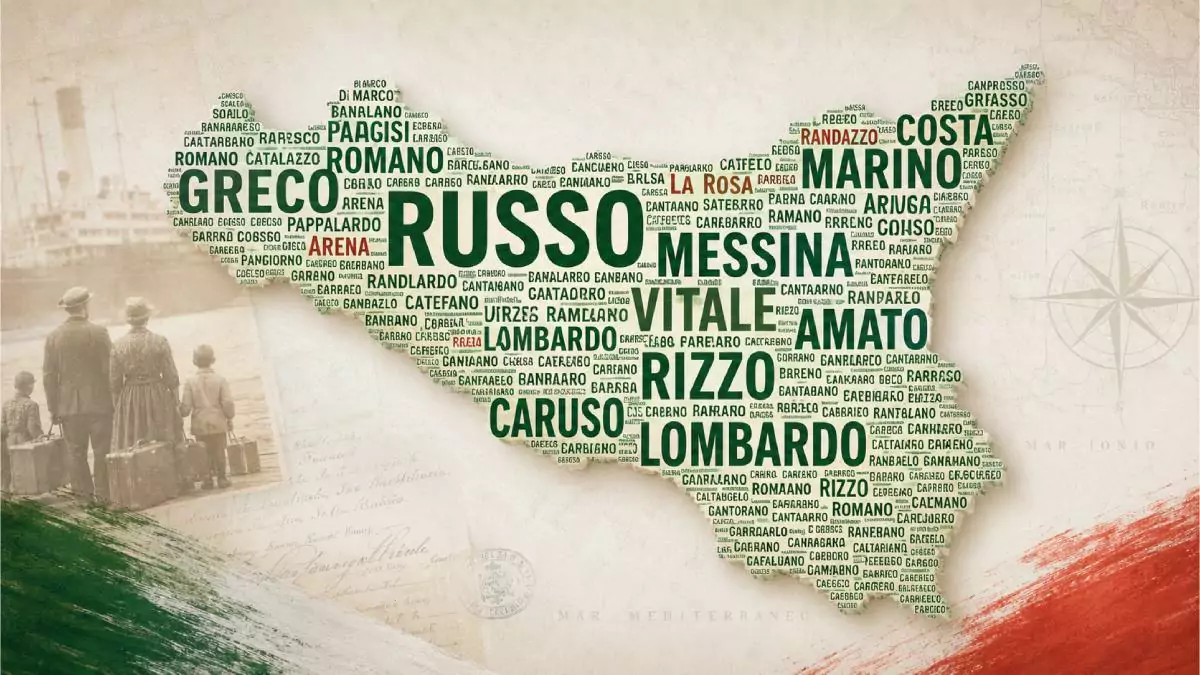
Among the names that dominate Campania are Esposito, given to foundlings, and Russo, the southern equivalent of Rossi — although these are present throughout Italy. Also appearing are Luongo, Riccio, Fusco, Peluso, Barbato, Caputo, Capuozzo, and Palumbo, in addition to suffixes that reveal the region, such as “iello” and “illo,” in Borriello.
The “L” stuck to the name
A curious feature appears in Basilicata and its surroundings, including northern Calabria and western Puglia: the article attached to the name. Instead of "La Rocca" or "La Torre," the surname becomes Larocca, Latorre, Labella, and Lagioia. It's a trait that helps pinpoint the family's origin in that part of the country.
Surnames that tell you where the family came from.
In the South, many surnames indicate origin, city, or people. This is the case with Calabrese, Cosentino (from Cosenza), Genovese, Palermo, and Greco. Others come from occupations and positions, such as Pastore (shepherd), Forgione (one of the words for blacksmith), and Iodice (judge). And there are patronymics, headed by De Luca and De Rosa.
Explaining: Surnames in the South
- It ends in “o”: the effect of transcription in registry offices (Esposito, Russo, Caruso)
- “iello” and “illo”: typical suffixes of the region (Borriello)
- Attached article (La-): Basilicata and surroundings (Larocca, Latorre)
- Provenance: origin in a city or town (Calabrian, Cosentino, Genoese)
(Trends indicated by onomastics, with regional exceptions.)
Read also Veneto, Lombardy and Trentino: what the surname reveals about Northern Italy
Together, the North and South almost complete the map of Italian immigration in Brazil: Veneto and Lombardy marked Rio Grande do Sul and Santa Catarina; Campania and neighboring regions, São Paulo and Espírito Santo. As always, the ending points to a trend, not a certainty, but it's a good first thread to pull in the search for the commune. (With information from Treccani)