





















Not every Italian surname originated from a profession, a city, or an important family. Many arose from something far less solemn: a nickname.
A physical defect, a striking feature, strange behavior, or even a joke could serve to identify someone within a community. Over time, that nickname ceased to belong to just one person, passed on to descendants, and eventually became a surname.
This is how names that seem perfectly common today may have less than flattering meanings in their origin.
According to the onomast Enzo Caffarelli, Italian Rivista di OnomasticaA large proportion of Italian surnames derive precisely from nicknames. The logic was simple: no one needed to be identified by what they had in common, but by what differentiated them from others.
The Supreme Court reaffirmed: citizenship is born with the person.
- New legal front opened
- Processes can still be filed.
- Individual assessment before any decision.
As Caffarelli explains, nicknames tended to highlight "the most striking and therefore most original aspect of the person."
Fat, short, ugly, and lame.
It is from this custom that surnames such as Grassi, related to "fat people," Bassi, to "short people," Lunghi, to "tall people," Sordi, to "deaf people," and Nani, to "dwarfs," originated.
The list becomes less delicate when Brutti, associated with "ugly" people, Gobbi, with "hunchbacks," and Zoppi, with "lame" people, appear.
There are also harsher forms, such as Malfatti, literally "badly made," Malvestiti, "badly dressed," and Storpi, associated with crippled people or those with some kind of deformity.
Today, of course, no one who bears one of those surnames is being described by it. But, centuries ago, a characteristic of that kind could be enough to distinguish one person from another.
When the head became a surname
Another curious aspect of this universe lies in surnames formed from the word. forehead, "head".
In Italy, forms such as Testadiferro (“iron head”), Testadura (“hard head”), Testagrossa (“big head”), Testalunga (“long head”), Testaquadra (“square head”) and Testadoro (“golden head”) appear.
These names did not necessarily have a single origin. Many Italian surnames are considered polygenetic, meaning that the same surname may have arisen independently in different places. cities or regions.
Someone known as "stubborn" in a community, for example, didn't need to be related to another person with the same nickname hundreds of kilometers away.
One nickname, many forms
As regional differences They also helped to multiply the number of surnames.
The term hunchbackThe word, for example, associated with "hunchback," appears in different forms throughout Italy. Among them are Gobbo, Gobbi, Gobbis, Gobbin, and Gobbetti.
The same characteristic could have a different ending depending on the dialect, the region, or how the name ended up being recorded.
Over generations, what initially described a person became detached from its original meaning and simply came to identify their descendants.
A surname no longer describes anyone.
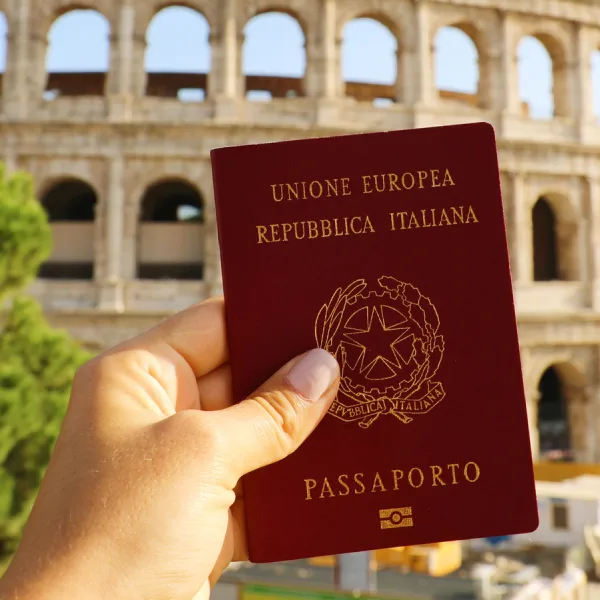
The Constitutional Court's decision changed the landscape. The new citizenship law will now be reviewed by the European Union's courts of justice.
That's precisely where the difference lies between the old nickname and the modern surname.
If someone acquired a name centuries ago related to their height, weight, appearance, or temperament, that would, at most, refer to the person who gave rise to the name.
Once a name became hereditary, it lost its descriptive function.
A Gobbi today doesn't need to have any characteristics related to the original meaning of the name. The same applies to those named Grassi, Bassi, Brutti, or Zoppi.
All that remained was the surname.
And that's precisely what makes these names interesting: they function as small linguistic fossils of an Italy where, long before identity documents and modern civil records, a single striking characteristic, a joke, or a nickname was enough to distinguish one person from another.
Centuries later, the mockery disappeared. The name remained.
Some surnames and their origins.
- Fat: Fat
- Bass: low
- Nani: dwarves
- Gobbi: hunchbacks
- Brutti: ugly
- Zoppi: one-armed
- Bad deeds: wrongdoings
- Malvestiti: poorly dressed
- Testadura: stubborn
- Testadiferro: iron head
- Testagrossa: big head















Leandro Picini
August 8 from 2026 at 16: 22
This article is great. My last name is Piccini, if I'm not mistaken it's associated with children, little ones, something like that. I know someone whose last name is Schiavo.
Clodoaldo Petini Petini
August 8 from 2026 at 18: 54
I'd like to know about Petini.
Fernando Bazzoli
August 8 from 2026 at 19: 13
In various internet sources, the surname "Bazzoli/Bazoli" is said to have a different etymological origin; some say it comes from a medieval given name, "Bazolo," while others say it originated as a nickname for a crazy person, or someone with a protruding chin.
Brognetta Guides
August 8 from 2026 at 19: 28
Does anyone know the meaning of Brogna, from the Brognetta family?
Dalvio Garcia
August 8 from 2026 at 20: 44
One of my ancestors received the surname Ghirello. The story goes that he was found in a convent's decorated circle. Since he already had two destinies, the nun, upon taking him out, thought he looked like a little squirrel. Because squirrel is called ghiro, she gave him the surname Ghirello, meaning little squirrel.
Edmar Bonamigo
August 8 from 2026 at 21: 32
I am a good friend.
Margareth
August 9 from 2026 at 01: 11
Very good article.
My last names are Zamperini and Canzian (on my father's side), De Nadai and Brunoro (on my mother's side).