

































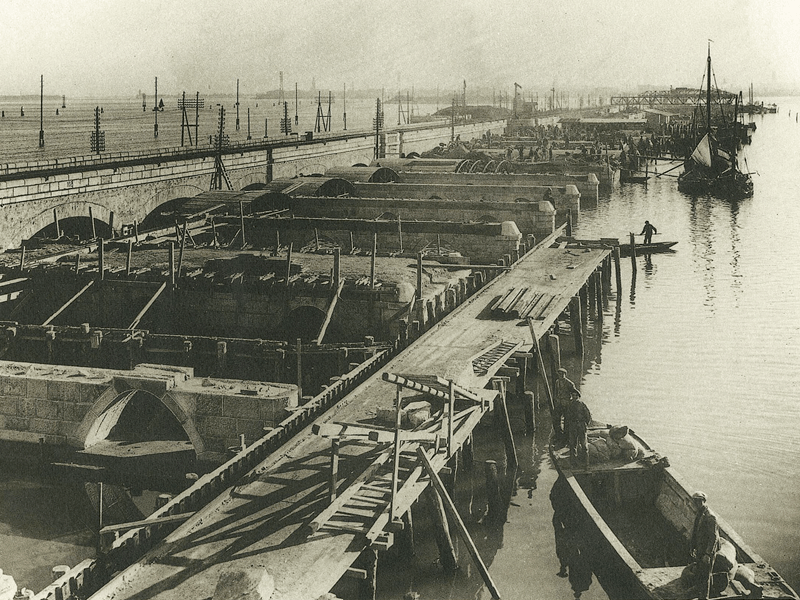
Until 1865 Venice was part of Austrian territory
It all began with the occupation of small islands in northeastern Italy. Inhabitants of the Veneto region fled there, fearing the hordes of barbarians who took over Europe from the 5th century onwards. The islands were part of the Byzantine Empire until the beginning of the 9th century, when Venice became independent. Soon, all the land areas of the islands were occupied and the city needed to grow. The solution was to advance over the waters that separated the islands. To do this, the Venetians developed a system to fill in the flooded areas attached to the land portions and thus narrowed the distance between the islands, delineating canals and gaining space to house larger settlements. Thanks to its privileged location – in the middle of the route between the East and the West –, excellent navigators and military power, the city became a prosperous mercantile and naval center from the 11th century onwards. This situation was only shaken when the Portuguese discovered an alternative route to the East, circling Africa. In 1797, with its military strength already weakened, the city was conquered by Napoleon and then became part of Austrian territory. It was only in 1866 that it was incorporated into Italy.
UNTIL THE 7TH CENTURY: DEVIRIGINATING THE ISLANDS
In the middle of a saltwater lagoon with an exit to the Adriatic Sea, 65 small islands served as the basis for the formation of the current city. The first inhabitants lived basically from fishing and salt extraction – essential for preserving fish meat and a valuable exchange product. The first densely populated towns in the lagoon are not part of the current historic center of Venice. The islands that today correspond to the neighborhoods of San Polo and San Marco – the main ones in the city today – only became popular in a period after this first settlement.
Path of the waters
Venice turned water into soil and now fights against the retaliation of the tides

The Supreme Court reaffirmed: citizenship is born with the person.
- New legal front opened
- Processes can still be filed.
- Individual assessment before any decision.
FROM THE 9TH CENTURY: STONE UPON STONE
The population increased and new spaces had to be created for construction. The solution was to expand the portions of dry land and even create new islands through landfilling. This occupation strategy shortened the distance between some islands, forming channels and enabling the emergence of larger buildings. Venice only began to be built in earnest in 810, when Rialto became the city's administrative center. See below the step-by-step guide on how the landfills were made:
1. The new boundaries were drawn using wooden pillars. They were 3 to 4,5 meters long and were embedded in the caranto, an underground layer of compacted clay. The thousands of buried and submerged pillars to this day are completely underwater. Without contact with atmospheric air, they do not rot
2. Wooden boards placed on top of the pillars served as support for blocks of limestone, extracted from Istria (current territory of Croatia). The stone foundation blocked the passage of water, enabling the subsequent deposit of earth – extracted from the bottom of the lagoon – between this dam and the island.
3. When the land reached the top of the dam (just above the water), brick walls were erected, establishing the island's new limits. In this way, narrow channels emerged between the islands and walkways were built to connect one to the other. Even so, boats continued to be the main means of transportation
|
TODAY: HERITAGE AT RISK
|
|---|
News originally published in Super interesting