


























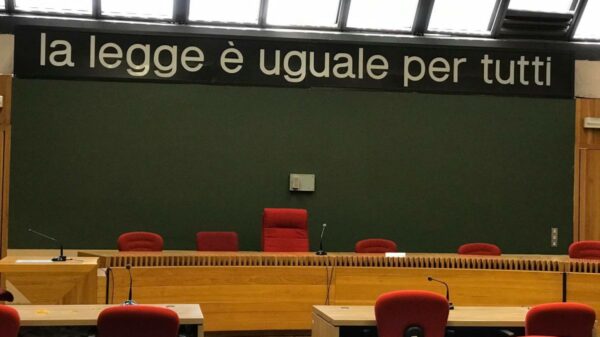











In a surprising turn of events, the Italian judiciary, which should be the impartial guardian of the law, now views Italian citizens by blood right as a “democratic risk” for the country.
It seems bizarre, but the president of the Veneto Court of Appeal, the Court of Appeal (Second Instance), Carlo Citterio, is sounding the alarm by pointing to the avalanche of requests for recognition of Italian citizenship, mainly coming from Brazil, as a danger to the democratic order for the Italian Republic.

During the inauguration of the judicial year, last Friday (26), the president expressed the need to balance judicial management and the constitutional rights of Italian-Brazilians.
But he argued that automatically recognizing citizenship for those with distant family ties and no contact with Italy could compromise the integrity of Italy's electoral processes. “They can vote and change electoral quorums, it is a democratic risk”, said the president of the Court of Appeal.
Citterio further expressed, according to the Corriere della Sera report, the need for a prudent review of legislation, aiming at the possibility of changes to the rules. “It is necessary to evaluate the opportunity for a possible, quick and wise review of the legislation”, said the president.
And he went further: he said that an in-depth study of a possible review of the rules is already being organized with the head of the Venice State Attorney's Office, Stefano Maria Cerillo, and the constitutionalist of the University of Padua, Sandro De Nardi.
The magnitude of the phenomenon is evident in the numbers presented: 12 thousand cases in one year, representing an average of one thousand per month.
However, behind each request there are entire families, bringing the estimate of applicants to between 100 and 150 people at the Venice Court alone.
Faced with the controversial prospect of considering Italian-Brazilians as a “democratic risk”, it is crucial to remember that the Italian community abroad has the legitimate right to claim its citizenship.
The justice system must be sensitive to diversity and ensure that the pursuit of Italian citizenship is not treated as a threat, but as a reflection of the historical and cultural bond that unites Italians around the world.
Any revision to legislation must therefore be carefully balanced to protect fundamental rights, promoting inclusion and civic participation, instead of creating unnecessary barriers.