





































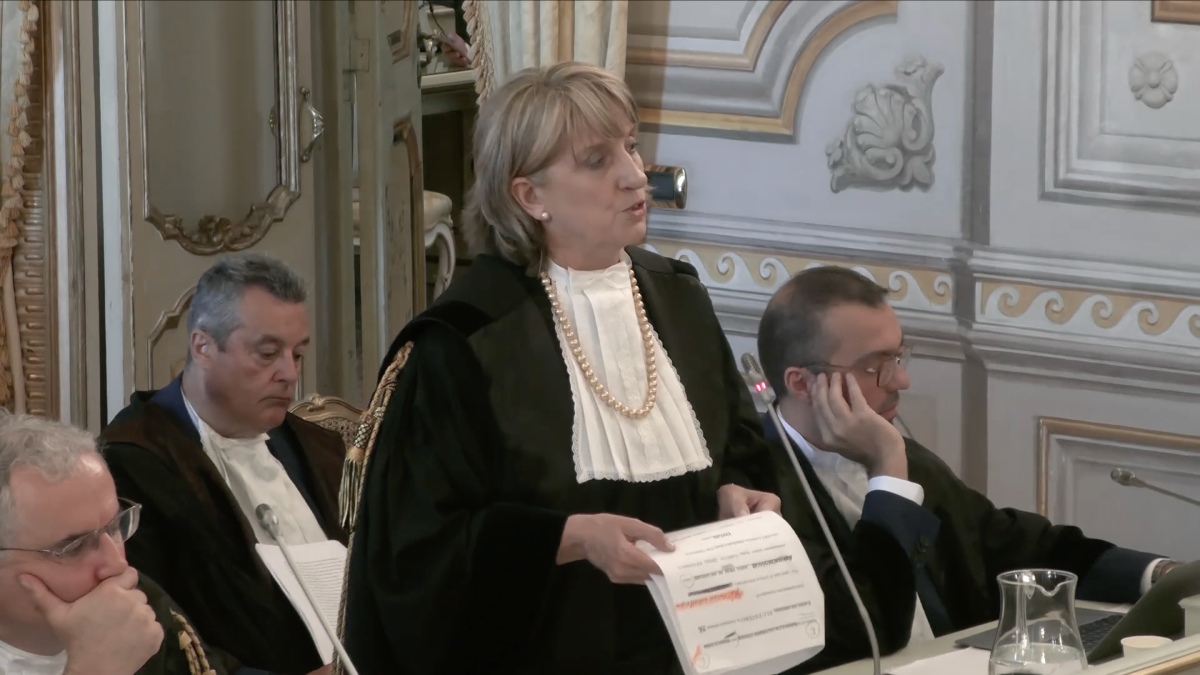
At the hearing this Tuesday, 24th, at the Constitutional Court of ItalyThe Italian-Argentine lawyer Monica Lis Restanio made an emotional and historic defense of Italian citizenship for descendants born abroad. Representing diaspora communities, she declared: “It is an existential, historical, transgenerational issue. A duty of recognition for those who, with sacrifice, preserved the values of Italianness as an indestructible legacy.”
“I would like to describe the practical side of the genuine bond and the regulations on citizenship applied until March 27,” she said. According to her, “the citizenship of the bipolid ius soli e jus sanguinis This involves two inseparable aspects: the link to Italy transmitted through family and the right to retain Italian citizenship, unless voluntarily renounced.

Restanio denounced that “the generational divorce between the ascendant and the applicants is not due to the lack of interest of the families, but to decades of obstruction by the administration”, which would have made it difficult to recognize the citizenship status (status civitatis), “sweeping across two or three generations”.
The lawyer criticized an “immutable administrative structure” that treats citizenship “as a discretionary concession and not as a binding right.” And she highlighted: “Until March, the laws on citizenship were perfect; so perfect that an economic barrier to justice was created.”
According to her, “the cost for a family of five has gone from 518 to 3 euros,” making appeals in the second instance or at the Court of Cassation unfeasible. “The bureaucratic reality surpasses all imagination. Consolados refuse to issue the tax code necessary to pay the fee for registering sentences.”
Restanio also accused Decree-Law 36 of 2025 of legalizing restrictive practices and destroying an “original, unavailable and imprescriptible right in force for over 150 years.” She lamented the use of “a media disinformation campaign” that “humiliates and defames Italians born abroad.”
“Even if the diaspora does not have the space it deserves in Italy, Italian communities abroad know their value well,” he said. “With their feet firmly on foreign soil, Italians born abroad are proud to embody deeply Italian values: family, work, faith, solidarity, respect for women and children.”
About the hearing
On Tuesday, the Italian Constitutional Court held a public hearing that could mark a turning point in legislation regarding Italian citizenship by descent. The trial, held in Rome, stemmed from a referral from the Bologna Court, published on November 26, 2024, which questioned the constitutionality of Article 1 of Law No. 91/1992, the law that until now recognizes Italian citizenship by descent. jus sanguinis, that is, by blood, without temporal limitation of generations.
Other courts — such as those in Rome, Milan, and Florence — have also suspended similar proceedings, awaiting a definitive ruling from the Constitutional Court.
The Court is analyzing whether this legal provision remains compatible with the principles of the Constitution of the Italian Republic, especially after the enactment of Law 74/2025, which converted the controversial Decree-Law No. 36/2025 – known as the Tajani Decree – and imposed new criteria for the recognition of citizenship. The law now requires, for example, that the applicant be the grandchild of an Italian citizen and prove exclusive blood ties or birth in Italy.