































Close ranks and create a system to grow.
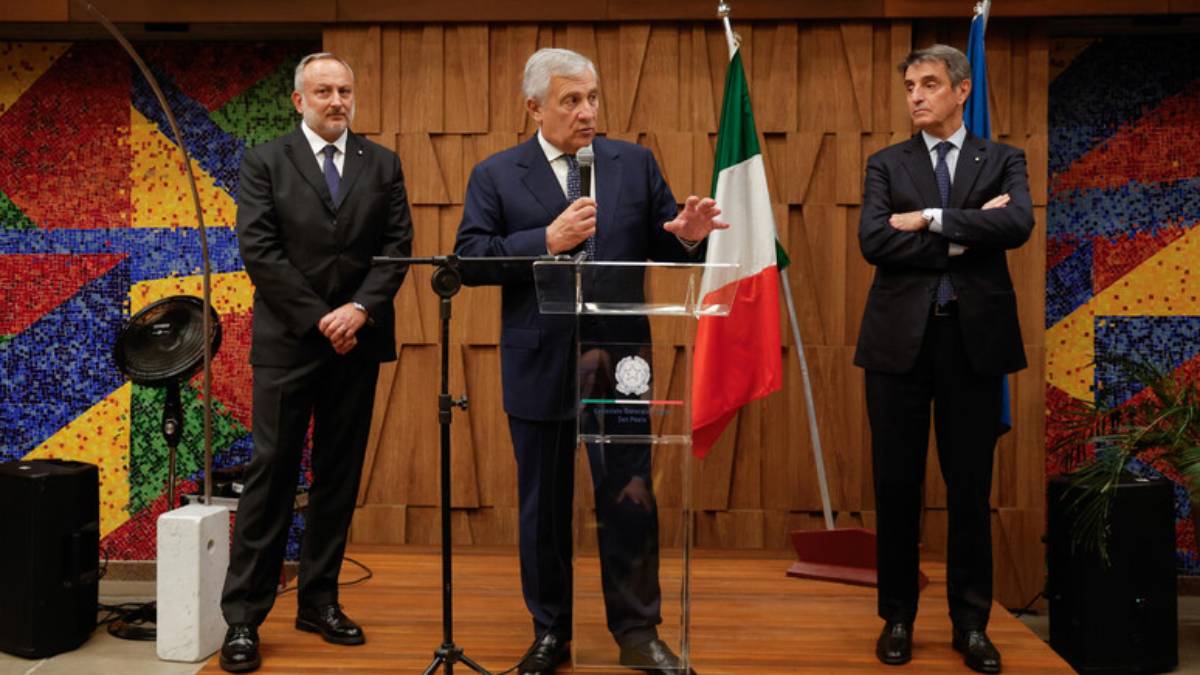
This is the message that the Deputy Prime Minister and Minister of Foreign Affairs, Antonio Tajani, sends to Italian companies arriving for the Italy-Brazil Business Forum, in São Paulo.

The delegation is made up of executives from major companies such as TIM, Enel and Leonardo, which have long since arrived in Latin America, but also managers and businesspeople who are interested in this market. “Know that you can count on the government,” Tajani assured several times, explaining that Italy’s goal is to reach 700 billion in exports by 2026 (from the current 626 billion).
“We will ensure that our diplomatic offices become a tool to further consolidate our business presence, and we are developing innovative financial initiatives with ICE, Simest, CDP and Sace. Exports represent 40% of our GDP, we cannot take steps backwards”, warned Tajani, noting that, with the negative moment of the automotive sector in Germany, it is necessary to work more in other markets.
“This mission is not isolated, it is the beginning of a phase. We will return, hold other business forums and work to ensure that there is a principle of reciprocity. We know that there is also resistance here in South America, of a customs and bureaucratic nature: we will do everything we can to bring these barriers down,” he stressed.
A few hours after meeting with Argentine President Javier Milei, Tajani met with São Paulo Governor Tarcísio de Freitas (who is expected to run for president in 2026) to further discuss possible collaborations. “We talked about infrastructure, hydrogen, alternative energy, rail networks, subways, construction,” he said.
Earlier in the evening, the minister also attended the inauguration of the São Paulo office of Simest, an agency of the Cassa Depositi e Prestiti group that manages funds for the Ministry of Foreign Affairs and is working on a package of financial measures worth more than 500 million euros to support exports and the internationalization of companies with interests in Latin America.
More than 200 million euros relate to a new subsidized financing measure with a rate of 0,50% and which provides for a reinforced non-refundable fund for companies in southern Italy.
In addition, 300 million euros should facilitate export contracts for goods and services in Latin America, granting medium and long-term extensions and minimizing financial costs associated with the discounting of payment titles.
In addition, new incentives dedicated to companies in energy-intensive industrial sectors will be improved. (HANDLE)